
Social Housing Regulation Update (May 2023)
The approach to social housing regulation is changing in response to the well documented tragedies of Grenfell, and the death of Awaab Ishak. The new Ofsted style Inspections give the Regulator of Social Housing increased powers and rights of intervention.
The Regulator of Social Housing will inspect housing providers every four years, they will have powers to intervene in the running of social housing providers operations, and powers to enter homes and carry out emergency repairs that the landlord has not completed. They will have the power to impose unlimited fines on social housing providers who are in breach of the regulatory requirements. These changes in the regulatory approach represent the biggest change since the introduction of Key Lines Of Enquiry (KLOE’s) and inspection in the early 2000’s.
The information below is designed to help TMO’s prepare for these changes.
Social Housing Regulation Bill 2022
The Bill is an official set of proposals published by the Government to indicate the nature and scope of future legislation. It sets out a New Charter for Social Housing tenants that is backed up by a stronger regulatory regime.
TMOs are not regulated separately to their local authority partner, but the relationship between the TMO and their local authority will be based in part upon the requirements of the Housing Regulator. TMOs need to be aware of developments in the regulatory approach to make sure their Governance arrangements are robust.
We can expect our stock owning local authority partners to develop more stringent assurance processes in their monitoring of our performance, and we must be able to produce robust evidence of our performance and compliance with the requirements of the Bill.
A recent amendment to the Bill is that professional standards must be raised in the social housing sector. To achieve this, it is required that Social Housing Managers should have qualifications regulated by Ofqual equivalent to a Level 4 or 5 Certificate or Diploma in Housing, or a foundation degree from the Chartered Institute of Housing. This will have significant implications for smaller providers in terms of training budgets and recruitment.
The role of the Regulator of Social Housing is being strengthened.
The White Paper which this Bill is based upon extolls the themes of safety security and dignity. It emerged as a result of the Grenfell tragedy and identifies Customer Voice, quality accommodation and effective complaints processes as key to assuring safety security and dignity.
It establishes seven key requirements, or obligations that landlords must satisfy:
- To be safe in your home. Working with industry and landlords to ensure every home is safe and secure.
- To know how your landlord is performing, including on repairs, complaints, and safety, and how it spends its money, so you can hold it to account.
- To have your complaints dealt with promptly and fairly, with access to a strong ombudsman who will give you swift and fair redress when needed.
- To be treated with respect, backed by a strong consumer regulator, and improved consumer standards for tenants.
- To have your voice heard by your landlord, for example through regular meetings, scrutiny panels or being on its Board. The government will provide help, if you want it, to give you the tools to ensure your landlord listens.
- To have a good quality home and neighbourhood to live in, with your landlord keeping your home in good repair.
- To be supported to take your first step to ownership, so it is a ladder to other opportunities, should your circumstances allow
Detailed chapters and self-evaluation
| Theme | Requirements | Actions |
| Home safety | There should be a Nominated person responsible for complying with Health and Safety (H&S) | Scope and conduct an internal H&S assurance process. |
| Compliance with the enhanced regulatory regime in the Building Safety Act 2022 | Produce a detailed, evidenced statement showing compliance with the requirements of the Building Safety Act 2022 | |
| Transparency in landlord performance | Landlord performance on matters that are of concern to tenants should be clear, up to date, and easily accessed. | Publish performance information every quarter that includes compliance with consumer standards and TSMs |
| There should be regular reporting on compliance with the Consumer Standards including the Tenant Satisfaction Measures (TSM’s) | Publish a clear breakdown of how income is spent to tenants | |
| A senior person should be nominated to ensure compliance with the consumer standards set by the Regulator of Social Housing | Review compliance with the Consumer standards and publish the outcome and any action plans | |
| Complaints dealt with promptly and fairly | The TMO should Self assess against the Housing Ombudsman’s Complaint Handling Code and publish a statement of compliance | Self-Assess against the Ombudsman Standard |
| Make clear to tenants how to complain, and make it as easy to do so as possible | Communicate to tenants how to complain | |
| Publicise details of cases determined by the Housing Ombudsman | Publicise details of cases determined by the Housing Ombudsman | |
| Strong resident engagement | Tenants must have opportunities to influence service delivery and hold the landlord to account. | Draw up a programme of tenant engagement around the key services and publish outcomes and action plans. |
| Good quality homes | All properties must meet the Decent Homes Standard | Deliver a programme of stock condition assurance and property MOTs to include Energy Performance Certificates (EPC’s). |
| Deal effectively with Anti-Social Behaviour (ASB) | Publish information that makes clear service standards for ASB, and the tools available to deal with it. | |
| Allocate Housing in the fairest way possible | Publish the allocation policy, provide support with applying, report on allocations made. | |
| Promote home ownership | Information on Right to Buy and other ownership models in the sector should be made available. | Provide information on home ownership options in the area. |
Compliance with Housing Regulatory Standards
The Regulator of Social Housing regulates in relation to three types of standards:
1. Economic Standards
2. Consumer Standards
3. Tenant Satisfaction Standards
1. Economic standards
(i) Governance and Financial Viability Standards
This standard requires housing providers to have sound governance and financial management systems in place to ensure their long-term viability. It requires that Boards have sufficient information to understand and challenge these systems, and that they can manage risk appropriately.
(ii) Value for Money Standards
This standard requires housing providers to deliver value for money in their services and operations. It requires evidence of efficiently, effectiveness, minimising costs, having proper procurement arrangements, and providing good quality services that meet the needs of the customer
(iii) The Rent standard
This standard has two key elements: rent setting, and service charges.
- Rent setting
Housing providers must set rents that are affordable, and the mechanism must be transparent and consistent with the regulatory framework. Rents should be set at levels that allow the provider to cover its costs, while also providing value for money to the tenant.
- Service charges
Housing providers may charge for additional services such as heating and lighting. Service charges must be reasonable, transparent, and based on actual costs incurred by the provider.
Providers must consult with tenants on their rent setting policy and provide clear and accessible information about it.
2. Consumer Standards
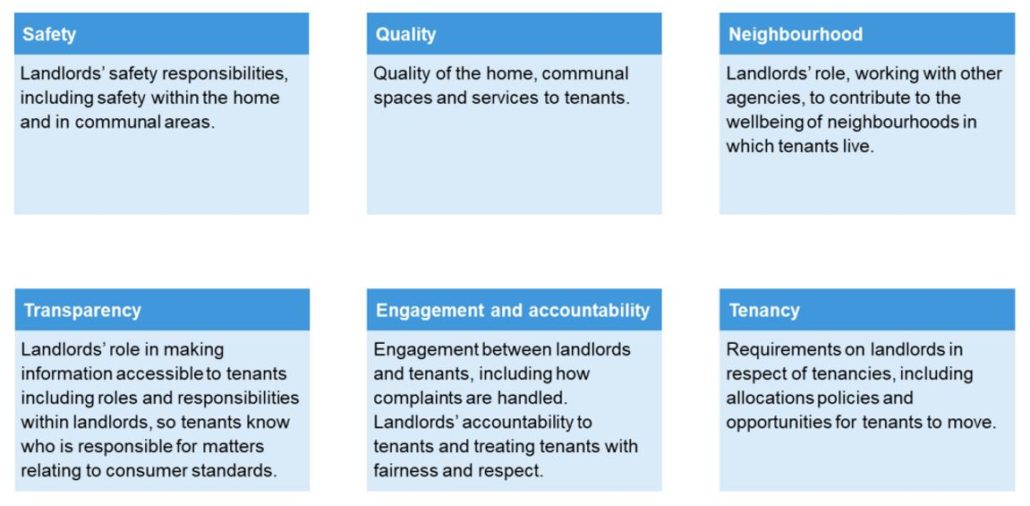
(i) Safety
This standard relates to the compliance regime, and the importance of maintaining effective systems to ensure the safety of people’s homes. It draws heavily on the Building Safety Act 2022
(ii) Engagement and accountability
This standard requires housing providers to involve and empower tenants in decision making processes that affect them. It includes requirements such as providing clear and accessible information, consulting tenants on issues that affect them, and enabling tenants to participate in decision making.
(iii) Quality
This standard requires providers to make sure their homes are safe, decent and in good repair, and that property-based services to tenants achieve KPI targets and deliver a responsive service that tenants are satisfied with.
(iv) Tenancy
This standard requires providers to offer tenancies that are fair, transparent, and flexible. It includes information on providing clear information on tenancy terms and conditions, letting homes in a fair and transparent way considering housing needs demonstrating that we make the best use of available housing, are compatible with the purpose of the housing, and contribute to the local authorities strategic housing function and sustainable communities. Providers must provide a clear application and appeals process, and facilitate transfer and exchange by way of internet enabled systems
(v) Neighbourhood Standard
This standard requires housing providers to promote and support thriving neighbourhoods and communities. It includes the requirement to work with other agencies to improve the local environment, support community initiatives, and address anti-social behaviour and other issues that affect quality of life in local areas.
(vi) Transparency
This standard requires housing providers to develop a culture of openness in which it is easy for tenants to access information, understand the quality of service that is to be provided and challenge when it falls short. The Tenant Satisfaction measures support this standard.
3. Tenant Satisfaction Measures
There are twenty-two tenants’ satisfaction measured covering five themes.
The five themes are:
1] keeping properties in good repair,
2] maintaining building safety
3] respectful and helpful engagement
4] effective handling of complaints and
5] responsible neighbourhood management
These measures are designed to assess how well social housing providers are meeting the needs and expectations of their tenants and to drive improvements in the quality of social housing services.
| Keeping properties in good repair | TP01: Overall satisfaction | TP02: Satisfaction with repairs | TP03: Satisfaction with time taken to complete most recent repair | TP04: Satisfaction that the home is well-maintained | |
| RP01: Homes that do not meet the Decent Homes Standard | RP02: Repairs completed within target timescale | ||||
| Building safety | TP05: Satisfaction that the home is safe | ||||
| BS01: Gas safety checks | BS02: Fire safety checks | BS03: Asbestos safety checks | BS04: Water safety checks | BS05: Lift safety checks | |
| Respectful and helpful engagement | TP06: Satisfaction that the landlord listens to tenant views and acts upon them | TP07: Satisfaction that the landlord keeps tenants informed about things that matter to them | TP08: Agreement that the landlord treats tenants fairly and with respect | ||
| Effective handling of complaints | TP09: Satisfaction with the landlord’s approach to handling of complaints | CH01: Complaints relative to the size of the landlord | CH02: Complaints responded to within Complaint Handling Code timescales | ||
| Responsible neighbourhood management | TP10: Satisfaction that the landlord keeps communal areas clean and well-maintained | TP11: Satisfaction that the landlord makes a positive contribution to neighbourhoods | TP12: Satisfaction with the landlord’s approach to handling anti-social behaviour | NM01: Anti-social behaviour cases relative to the size of the landlord |
What should TMOs do?
TMOs should self-assess against these requirements and prepare an annual report to tenants which sets out how well the TMO is doing in relation to these requirements and what actions plans are in place to improve compliance.
How can the NFTMO help?
The NFTMO can help by supporting you in a self-assessment, putting you in touch with other TMOs who are working on the same issues, running best practice workshops, and acting as a critical friend before you publish your annual report.
